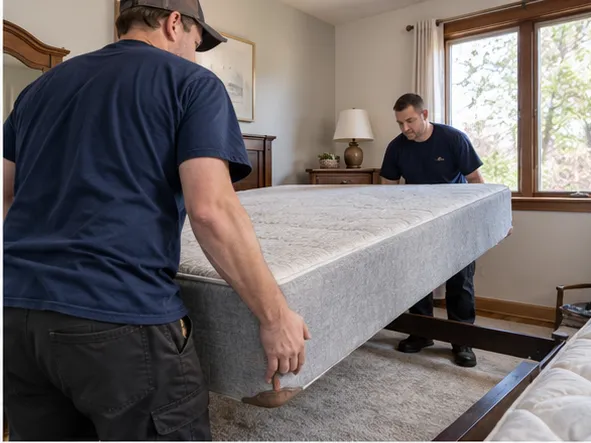
Measure a box spring as a rigid object. Even when its fabric cover looks soft, the wood or metal frame controls how it moves through a doorway or stair turn.
Record the foundation dimensions
Measure length, width and depth at the widest points. Note whether the set is one piece or split into two sections. Split foundations are often easier to route, but each piece still needs a clear path.
Check for legs, brackets or attached hardware that extend beyond the frame. Do not assume those parts can be removed without tools.
Measurements that matter
- Box spring length, width and depth
- Bedroom and exterior door clear openings
- Hall width at the tightest point
- Stair width, landing depth and ceiling clearance
- Elevator door and interior dimensions, if used
Find the limiting turn
A straight hallway can still end at a tight ninety-degree turn. Measure the landing or intersection where the box spring must rotate. Railings, trim and door handles reduce the practical opening.
If the item entered before a remodel or was assembled inside the room, tell the provider. Cutting a foundation can expose staples, wire and wood, so it should not be treated as a casual do-it-yourself step.
Pair the measurements with photos
Take one photo of the entire box spring and one of each tight access point. A wide photo of a stair landing is more useful than a close-up of the fabric.
Review the box spring removal page and email the measurements. The provider can then decide what else needs to be checked before scheduling.